
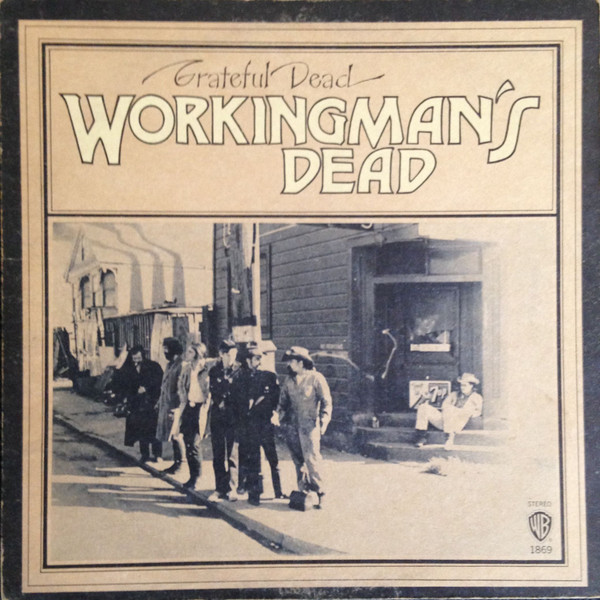
Workingman's Dead is a Rock album by The Grateful Dead, originally released in 1970. On Gatefold: 180 pressings tracked, owned by 60 collectors.
Sound DNA
- Rock
- Folk Rock
- warm
- laid-back
- pastoral
About
When the Grateful Dead convened to record <i>Workingman’s Dead</i> in February 1970, they were intent on change. They wanted something lighter, simpler; something closer to a folk or country record than a psychedelic one. Conveniently, they were also deep in debt to their record company and trying to extract themselves from a recent—and costly—drug bust. Their previous album, <i>Aoxomoxoa</i>, took nearly six months at the cost of more than a million dollars in today’s money; <i>Workingman’s Dead</i> was done in nine days. The band was spending more and more time on Mickey Hart’s ranch up north, shooting guns, riding horses, and generally communing with the land. They were cowboys now, singing cowboy songs: the card-game gamble of “Dire Wolf,” the rustic fever dream of “Black Peter.” Robert Hunter, the band’s lyricist, became a more prominent member and, in turn, enlarged the share of narrative in the band’s sound, creating a world that felt both contemporary and oddly ancient, in which American folk figures (the train conductor of “Casey Jones,” the miners of “Cumberland Blues”) commingled with archetypes from dreams and myths. The psychedelia of <i>Workingman’s Dead</i> didn’t lie in sound effects, but in the way it flattened time, blurring the line between 1870 and 1970, between the frontiers of the gold rush and of the counterculture, of a past that, as it turned out, could still be felt with the correct (ahem) kind of goggles. The album didn’t just chart a new course for the band, but for the counterculture in general. Tour buses had started running through Haight-Ashbury, turning hippies into a sideshow. Visionaries with the wherewithal were going back to the land, trying to hatch Utopia outside the glare of Nixon’s America. While the more experimental side of psychedelia branched into prog rock, <i>Workingman’s Dead</i>—alongside similar albums by The Flying Burrito Brothers and The Byrds—helped plant the seeds of what eventually became Americana, bridging the philosophical orientation of the hippies with folk and country, reclaiming old-fashioned music for a new generation. With <i>Workingman’s Dead</i>, they reached into the books and caught a glimpse of the future.
via Apple Music
The Clerk's got thoughts on this one. Mosh members get the full take →
Tracklist
Side A
- A1Uncle John's Band4:42
- A2High Time5:13
- A3Dire Wolf3:13
- A4New Speedway Boogie4:05
Side B
- B1Cumberland Blues3:15
- B2Black Peter5:42
- B3Easy Wind4:59
- B4Casey Jones4:24
Credits
Performers
- Phil LeshBASS VOCALS
- Bill KreutzmannDRUMS
- Mickey HartDRUMS PERCUSSION
- Bob WeirGUITAR VOCALS
- Ron "Pigpen" McKernanKEYBOARDS VOCALS HARMONICA
- Jerry GarciaLEAD GUITAR PEDAL STEEL GUITAR VOCALS
- David NelsonACOUSTIC GUITAR
- Tom ConstantenKEYBOARDS
60 collectors on Gatefold own this · 180 pressings tracked on Gatefold