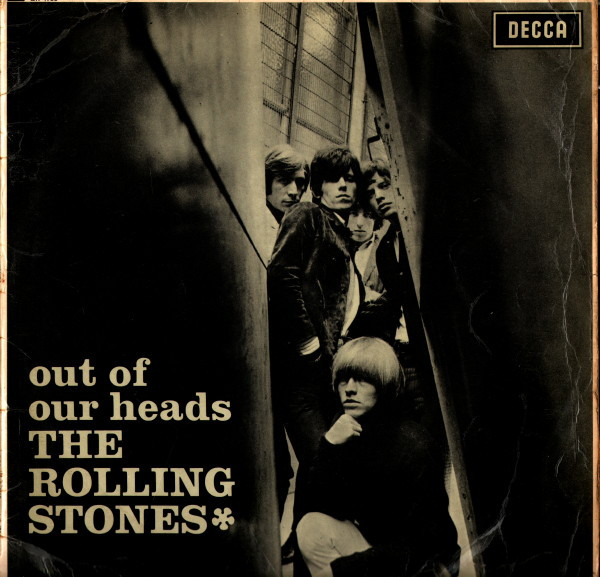
Out Of Our Heads is a Rock album by The Rolling Stones, originally released in 1965. On Gatefold: 382 pressings tracked, owned by 47 collectors.
Sound DNA
- Rock
- Garage Rock
- gritty
- swaggering
- bluesy
About
When The Rolling Stones came to Chess Studios in Chicago in the summer of 1964, they were met by a middle-aged Black man standing on a ladder painting the ceiling: Muddy Waters—a figure so important in the band’s origin story they named themselves after one of his songs. And there he was, painting the ceiling. The band’s project had always been, in part, reparational: They wanted the Black musicians they loved to get the money and recognition the band felt they deserved. Waters had toured Europe a year earlier as part of the American Folk Blues Festival, a package that presented blues not as a living, breathing art form, but as a fixed cultural export, the kind of thing you might see in a museum. Getting people interested in guys like Muddy Waters, Howlin’ Wolf, and Willie Dixon—that would’ve been nice. Getting them to realize Waters, Wolf, and Dixon were still alive and trying to make a living—at a time when Black America was aching from the struggle for civil rights—would’ve been even better. Released in July 1965—and recorded at Chess starting in November the previous year—<i>Out of Our Heads</i> was a pivot point. The Stones were still covering blues and soul—Marvin Gaye’s “Hitch Hike,” Sam Cooke’s “Good Times,” Solomon Burke’s “Cry to Me”—but they were also discovering their own identity, folding in hints of country (“The Spider and the Fly”), English folk (“Play With Fire”), and rockabilly (“The Last Time”). Then there was “(I Can’t Get No) Satisfaction.” Where the pop artist (and future collaborator) Andy Warhol argued that liking and buying were viable forms of self-expression, the Stones took a more athletic stance: They wanted stuff—fast cars, white shirts, game girls—but were embarrassed to admit it; they liked buying, but didn’t want to be sold. Ten years later, you’d call the same attitude “punk.” That their first take of “Satisfaction” had been recorded at Chess was poetic: In a studio whose music they had been defined by, they learned to define themselves. Otis Redding covered the song almost immediately, noting that if the words in his version sounded different, it’s because he’d made them up. Rock ’n’ roll.
via Apple Music
The Clerk's got thoughts on this one. Mosh members get the full take →
Tracklist
Side A
- A1She Said Yeah
- A2Mercy, Mercy
- A3Hitch Hike
- A4That's How Strong My Love Is
- A5Good Times
- A6Gotta Get Away
Side B
- B1Talkin' 'Bout You
- B2Cry To Me
- B3Oh, Baby (We Got A Good Thing Going On)
- B4Heart Of Stone
- B5The Under Assistant West Coast Promotion Man
- B6I'm Free
Credits
Performers
- Bill WymanBASS BASS GUITAR
- Charlie WattsDRUMS PERCUSSION
- Brian JonesGUITAR HARMONICA PIANO
- Keith RichardsGUITAR VOCALS LEAD GUITAR
- Mick JaggerHARMONICA VOCALS LEAD VOCALS
- Ian StewartMARIMBA PIANO ORGAN
- J. W. AlexanderPERCUSSION
- Jack NitzschePERCUSSION PIANO ORGAN
- Phil SpectorBASS BASS GUITAR SYNTHESIZER
47 collectors on Gatefold own this · 382 pressings tracked on Gatefold