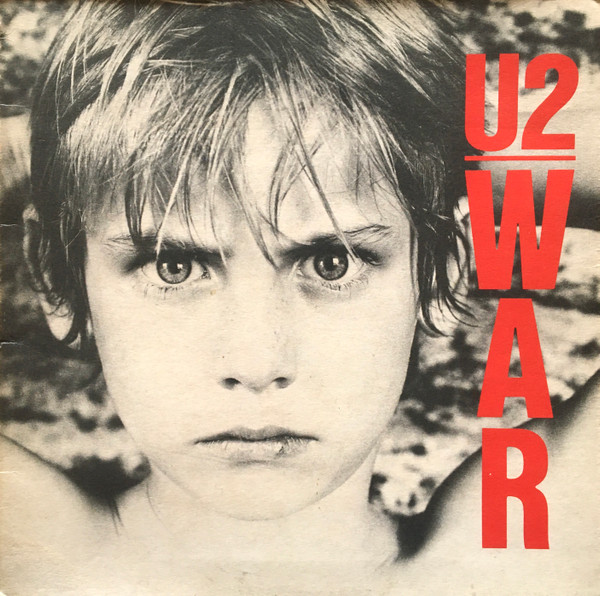
War is a Alt/Indie album by U2, originally released in 1983. On Gatefold: 509 pressings tracked, owned by 86 collectors.
Sound DNA
- Alt/Indie
- Alternative Rock
- raw
- defiant
- political
About
In early 1983, U2 lead singer Bono tried to predict how listeners would react to his band’s new album: <i>War</i>, Bono told a reporter, would feel like a “slap in the face.” It was almost an understatement, as pretty much <i>everything</i> about U2’s third record—from its opening drum-march to its politically agitated lyrics to its title—was steeped in confrontation. Thanks to early breakout hits like “I Will Follow” and “Gloria,” U2 had made a name for themselves. Now, they wanted to make a point. Working again with Steve Lillywhite, who’d helped shape the jagged-glory sounds of <i>Boy</i> and <i>October</i>, U2 headed into Dublin’s Windmill Lane Studios in 1982 with an arsenal of songs and no shortage of talking points. Bono and the other members of U2 (guitarist the Edge, bassist Adam Clayton, and drummer Larry Mullen Jr.) were young men in their twenties, a time when the world should have felt wide open. And yet the news was serving up one early-1980s disruption after another: violence in Northern Ireland. Unrest across Europe. And a seemingly constant threat of worldwide nuclear annihilation. U2 decided to address those dangers head-on, lyrically <i>and</i> musically. “Sunday Bloody Sunday” opens <i>War</i> with a wallop: a flurry of military percussion, stabbing guitar lines, and anguished electric violin squelch, all of which serve to amplify Bono’s fury and frustration about the Troubles in Northern Ireland. “New Year’s Day”—the album’s first single, and an unlikely chart-climber—employs tight harmonies and some aptly chilly piano lines in what must be the only international pop hit to be inspired by the Solidarity movement in Poland. And you don’t have to dig too deep to find Bono’s nuclear fears surging through “Seconds” (“Push the button and pull the plug/Say goodbye, oh, oh, oh”). Yet for all the real-world ferocity that creeps into <i>War</i>, the album also finds Bono slowing down to find solace in his faith: “Drowning Man,” an eerie and ethereal throwdown for God that takes the electric violin of “Sunday Bloody Sunday” into a gentler, dreamier direction. And the album’s closing number, “40,” which was recorded in a last-minute rush, takes inspiration from Psalm 40, and closed the band’s live shows for years to come. Faith, fear, politics—with <i>War</i>, the members of U2 pushed their hot-topic passions into the rock ’n’ roll discourse, and found that the more they turned up the volume, the more people wanted to listen (in the UK, <i>War</i> pushed Michael Jackson’s <i>Thriller</i> off the top of the charts). To listeners, <i>War</i> may have been a slap in the face. But to U2, it was a welcome kick in the ass—the record that pushed them to keep pushing.
via Apple Music
The Clerk's got thoughts on this one. Mosh members get the full take →
Tracklist
Side A
- A1Sunday Bloody Sunday4:38
- A2Seconds3:09
- A3New Year's Day5:38
- A4Like A Song…4:48
- A5Drowning Man4:12
Side B
- B1The Refugee3:40
- B2Two Hearts Beat As One4:00
- B3Red Light3:46
- B4Surrender5:34
- B5"40"2:36
Credits
Performers
- Adam ClaytonBASS
- Larry MullenDRUMS PERCUSSION
- The EdgeGUITAR PIANO LAP STEEL GUITAR
- Ken FradleyTRUMPET
- BonoVOCALS GUITAR VOCAL PERCUSSION
- Steve WickhamELECTRIC VIOLIN VIOLIN ELECTRIC BASS
- Adriana KaegiBACKING VOCALS
- Cheryl PoirierBACKING VOCALS
- Jessica FeltonBACKING VOCALS
- Taryn HageyBACKING VOCALS
86 collectors on Gatefold own this · 509 pressings tracked on Gatefold