
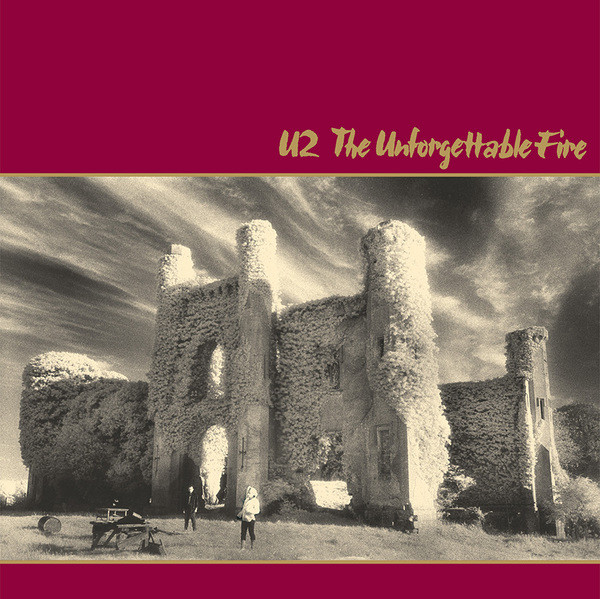
The Unforgettable Fire is a Alt/Indie album by U2, originally released in 1984. On Gatefold: 460 pressings tracked, owned by 67 collectors.
Sound DNA
- Alt/Indie
- Britpop
- jangly
- uplifting
- urban
About
By the mid-’80s, it had become clear to the members of U2 that <i>War</i> was over. That 1983 album had given the group an early taste of international fame—not to mention its first hit single, thanks to “New Year’s Day.” But the thrills of victory had been short-lived: After a lengthy stint on the road, bandmates Bono, the Edge, Larry Mullen Jr., and Adam Clayton returned to Ireland, unsure of where U2 could go next. All they knew was that the brittle, ear-bending guitar attack they’d perfected over several years was starting to bore them. In search of inspiration, the band members decamped to the 200-year-old Slane Castle, a vast and isolated space not too far outside Dublin, where they could try out ideas round the clock. They also decided to part ways with producer Steve Lillywhite—who’d overseen their first three efforts—and partner with Daniel Lanois and Brian Eno. Both men were unlikely recruits: By that point, Lanois had worked mostly with a series of well-regarded (but hardly world-beating) Canadian acts. The enigmatic Eno, meanwhile, had spent the early ’70s playing with art-glammers Roxy Music, and had recently been collaborating with the ever-daring Talking Heads. It was hard to imagine Eno <i>listening</i> to <i>War</i>—much less finding a common musical language with the guys who’d made it. But U2 needed to be pushed and prodded a bit. And Lanois and Eno—as producers, players, and in-studio philosophers—helped draw out the sounds that would define not only <i>The Unforgettable Fire</i>, but also U2’s future. During the Slane sessions, the group’s sucker-punching guitar approach was dialed back, as the Edge discovered an airier, more restrained guitar style (as announced by “A Sort of Homecoming,” the album’s gently urgent opening track). And while Bono’s lyrics remained bluntly to the point—never more so than on the MLK-adoring anthem “Pride (In the Name of Love)”—he allowed his songwriting to grow more diffuse, sometimes even abstract: The lulling “Promenade,” with its floating guitar chimes and synths, is one of U2’s all-time great love songs—a scribbled mash note of fleeting images and desires. Still, no song highlights U2’s baptism by <i>Fire</i> like “Bad,” a six-minute-long tale of addiction and affection—built on a simple but diabolically catchy Edge riff—that finds the band finally converting all of its raw aggression into panoramic passion. “Bad” would become a monster hit, especially on the road: The group’s 12-minute live rendition during 1985’s Live Aid would have marked that festival’s apex, had Queen not been waiting in the wings. And, like all the songs crafted with Lanois and Eno during the <i>Unforgettable Fire</i> sessions, it somehow gets louder the <i>quieter</i> it gets—and vice versa. <i>The Unforgettable Fire</i> wouldn’t be U2’s <i>biggest</i> album of the ’80s, but it remains its most <i>important</i>. The band members could easily have kept tapping into all the youthful fury that had fueled so much of their early work. Instead, they opted to twist and turn away, confident that listeners would follow along. And within the next few years, they’d redirect all of that anxious energy toward a new goal: conquering America once and for all.
via Apple Music
The Clerk's got thoughts on this one. Mosh members get the full take →
Tracklist
Side A
- A1A Sort Of Homecoming
- A2Pride (In The Name Of Love)
- A3Wire
- A4The Unforgettable Fire
- A5Promenade
Side B
- B14th Of July
- B2Bad
- B3Indian Summer Sky
- B4Elvis Presley And America
- B5MLK
Credits
Performers
- Noel KelehanARRANGED BY
- Adam ClaytonBASS
- Larry MullenDRUMS
- The EdgeGUITAR KEYBOARDS VOCALS
- Paul BarrettSYNTHESIZER KEYBOARDS
- BonoVOCALS
- Brian EnoVOCALS BACKING VOCALS
- Daniel LanoisVOCALS BACKING VOCALS
- Declan GaffneyKEYBOARDS
- Peter GabrielVOCALS
67 collectors on Gatefold own this · 460 pressings tracked on Gatefold