Album
Einstein On The Beach
Philip Glass / Robert Wilson
1979 · Classical
3 collectors on Gatefold own this
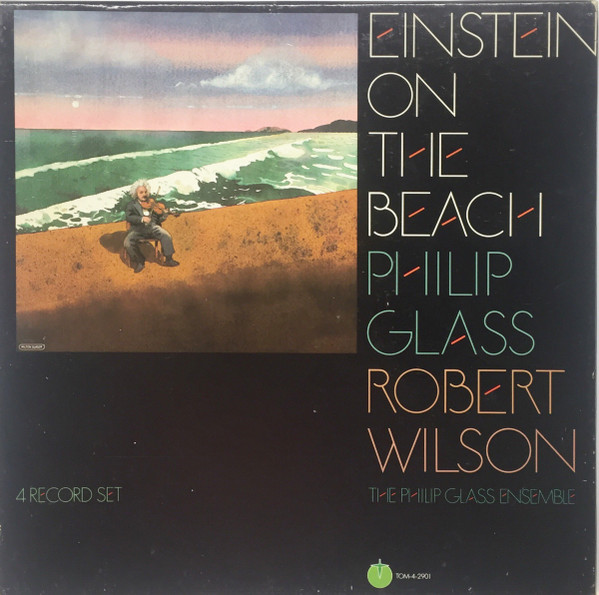
Einstein On The Beach is a Classical album by Philip Glass / Robert Wilson, originally released in 1979. On Gatefold: 18 pressings tracked, owned by 3 collectors.
About
Einstein on the Beach (1976) is a pivotal work in the oeuvre of Philip Glass. It is the first, longest, and most famous of the composer's operas, yet it is in almost every way unrepresentative of them. Einstein was, by design, a glorious "one-shot" - a work that invented its context, form and language, and then explored them so exhaustively that further development would have been redundant. But, by its own radical example, Einstein prepared the way - it gave permission - for much of what has happened in music theater since its premiere. Einstein broke all the rules of opera. It was in four interconnected acts and five hours long, with no intermissions (the audience was invited to wander in and out at liberty during performances). The acts were intersticed by what Glass and Wilson called "knee plays" — brief interludes that also provided time for scenery changes. The text consisted of numbers, solfege syllables and some cryptic poems by Christopher Knowles, a young, neurologically-impaired man with whom Wilson had worked as an instructor of disturbed children for the New York public schools. To this were added short texts by choreographer Lucinda Childs and Samuel M. Johnson, an actor who played the Judge in the "Trial" scenes and the bus driver in the finale. There were references to the trial of Patricia Hearst (which was underway during the creation of the opera); to the mid-'70s radio lineup on New York's WABC; to the popular song "Mr. Bojangles"; to the Beatles and to teen idol David Cassidy. Einstein sometimes seemed a study in sensory overload, meaning everything and nothing. The Glass-Wilson opera was intended as a metaphorical look at Einstein: scientist, humanist, amateur musician - and the man whose theories, for better and for worse, led to the splitting of the atom. Although it is difficult to discern a "plot" in Einstein, the climactic scene clearly depicted nuclear holocaust: with its renaissance-pure vocal lines, the blast of amplified instruments, a steady eighth-note pulse and the hysterical chorus chanting numerals as quickly and frantically as possible, it seemed to many a musical reflection of the anxious, fin-de-siècle late '70s. Einstein on the Beach brought the composer fame - and notoriety. It was presented throughout Europe in the summer of 1976, then brought to the Metropolitan Opera House for two sold-out performances in November 1976. Then, as later, audience response was mixed; Glass's works were presented to boos and bravos. There are several reasons, according to Glass. "To begin with, the new recording is almost 190 minutes long, as opposed to some 160 minutes in 1978," he said. "We were prisoners of the technology of the time and could only fit so much music on an LP side. The CD has changed everything. And length is not a trivial matter in a performance of Einstein but very much a part of the total experience." "And we just play the music so much more skilfully today than we could back in the 1970s. Back then, we were just learning the style. I imagine that the first performance of Einstein was probably a total mess but everything was so unusual and so new that nobody noticed. We were on a limited budget, so we had to hire singers who could also move and dancers who could also sing. Our chorus this time around is far superior to that on the first recording. Moreover, synthesizer technology has improved so enormously that we are able to create a more beautiful, sensual sound than we could have dreamed of in 1978." Little has changed in the music itself. Richard Peck's squalling sax improvisation in the "Building" movement has been replaced by what Glass calls a "very lyrical, bluesy solo." There is a new violinist (Gregory Fulkerson) on this recording and a new soprano (Patricia Schuman). Most of the speeches are the same, (the late Samuel Johnson's "All Men Are Equal" replaces his original "Paris" text, and a new actor, Jasper McGruder, has taken over Johnson's small but crucial roles), and Lucinda Childs and Sheryl Sutton are back to recreate their speaking parts. The score has many beauties: the pulsing, inevitable forward motion of "Train" (with its climactic exploration of a tricky, elegant modulation between F minor and E major, reprised throughout the opera); the slow, droning, quasi-hypnotic use of additive process in "Trial"; the furious, rhythmical reiterations of the dances; the sweet, gently rocking, solfege in the duet, "Night Train"; the loopy "Prematurely Air-Conditioned Supermarket" speech in "Trial 2/Prison" that leads, finally, to one of the most ecstatic outbursts of ensemble playing in the opera; the curious, detaché, aria for solo electric organ and soprano ("Bed"); and then the apocalyptic "Spaceship" movement. Ultimately, "Knee Play 5" brings it all back home and the mammoth opera ends rather as it began. (Tim Page).
via Last.fm
The Clerk says
The Clerk knows this whole record — the pressing quirks, the credits, the take.
Tracklist
Side A
- A1Knee Play 1
- A2Act I, Scene 1: Train
Side B
- BAct I, Scene 2: Trial
Side C
- C1Knee Play 2
- C2Act II, Scene 1: Dance 1 (Field With Spaceship)
Side D
- D1Act II, Scene 2: Night Train
- D2Knee Play 3
Side E
- EAct III, Scene 1: Trial/Prison
Side F
- F1Act III, Scene 2: Dance 2 (Field With Spaceship)
- F2Knee Play 4
Side G
- G1Act IV, Scene 1: Building/Train
- G2Act IV, Scene 2: Bed
Side H
- H1Act IV, Scene 3: Spaceship
- H2Knee Play 5
Sound DNA
- Classical
- Choral & Opera
- angular
- hypnotic
- cerebral
Notes from the original pressing. Later editions may differ.
Box set containing 4 LPs and 24 page booklet.
Recorded & mixed at Big Apple Recording Studios, New York, N.Y.
This recording of "Einstein on the Beach" contains all the music, lyrics and speeches from the original production of "Einstein on the Beach" as performed in Europe in the Summer and Fall of 1976 and at the Metropolitan Opera House in New York City in November 1976.
Runouts are etched, except the Wakefield plant ID is stamped.
Credits
The people behind it.
Performers
- Bruce BurroughsVOCALS
- Connie BeckleyVOCALS
- Dana ReitzVOCALS
- David AnchelBASS VOCALS MUSICIAN , BASS VOCALS
- David WoodberryVOCALS
- Dora OhrensteinALTO VOCALS MUSICIAN , ALTO VOCALS
- Forest WarrenVOCALS
- Frank ConversanoVOCALS
- George AndoniadisORGAN, CADENZA PERFORMER , WRITTEN-BY SOLOIST, ELECTRIC ORGAN, CADENZA
- Grethe HolbyVOCALS
- Iris HiskeyMUSICIAN , SOLO VOCAL MUSICIAN , SOLO VOCAL, VOICE MUSICIAN , VOICE
- Jeannie HutchinsVOCALS
- Jon GibsonFLUTE MUSICIAN , FLUTE MUSICIAN , SOPRANO SAXOPHONE
- Marc JacobiMUSICIAN , TENOR VOCALS TENOR VOCALS VOCALS
- Marie RiceVOCALS
- Michael RiesmanCHORUS MASTER CONDUCTOR CONDUCTOR, CHORUS MASTER
- Paul ZukofskyMUSICIAN , VIOLIN SOLOIST, VIOLIN VIOLIN
- Philip GlassELECTRIC ORGAN MUSICIAN , ORGAN ORGAN
3 collectors on Gatefold own this · 18 pressings tracked on Gatefold
Start your shelf.
Track your pressings of Einstein On The Beach, get the Clerk's take, and see what the record is worth — free.
Start your shelf →Free forever. Works with 10 records or 10,000.