
Album
Future Shock
1983 · Electronic, Hip Hop
48 collectors on Gatefold own this
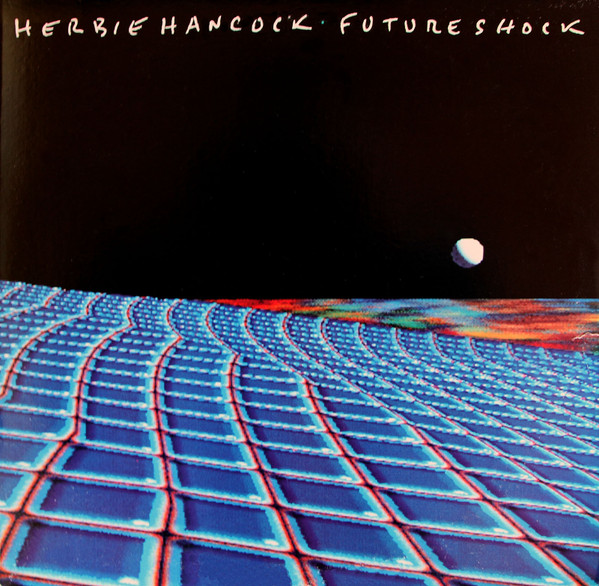
Future Shock is a Soul & Funk album by Herbie Hancock, originally released in 1983. On Gatefold: 103 pressings tracked, owned by 48 collectors.
About
To jazz fans, Herbie Hancock needed absolutely no introduction by the early 1980s. The former Miles Davis sideman, leader of such historic Blue Note sessions as <i>Maiden Voyage</i> and <i>Empyrean Isles</i>, had secured his legacy as one of the greatest pianists in the music. While the turntables and breakbeats of 1983’s <i>Future Shock</i> might have seemed a sudden turn toward pop commercialism, Hancock had followed Davis’ example and gone electric long before, first with his <i>Mwandishi</i> sextet, then on the highly successful <i>Head Hunters</i>, as well as later Columbia outings. All the while, he continued recording acoustic jazz of the highest rank, with the V.S.O.P. Quintet and his own trio. <i>Future Shock</i>, co-produced with Bill Laswell and his Material partner Michael Beinhorn, represented just one facet of Hancock’s artistry, but the hit single and video “Rockit”—and the resulting Grammy and MTV attention both earned—helped make him a household name. The response to <i>Future Shock</i> sparked much debate in the jazz world, especially between Hancock and young trumpet sensation Wynton Marsalis, who had played with such commanding fire on Hancock’s <i>Quartet</i> album just two years earlier. The criticism, not in so many words, was that Hancock had sold out. But by today’s lights, <i>Future Shock</i> is remarkably prescient in its defiance of genre boundaries, its embrace of technology, and especially in its beat-driven emphasis. One can question whether we need an eight-minute cover of Curtis Mayfield’s “Future Shock,” however well-sung by Dwight Jackson, Jr. But there’s much on this album to praise: Laswell’s incredibly slick bass line on “Earth Beat”; the emotive harmonic landscape of “TFS”; the ripping acoustic piano solo breaks on “Autodrive.” Hancock’s use of the Fairlight CMI—short for “computer musical instrument”—was undeniably innovative, not unlike his use of ARP and Moog synths a decade earlier. And Sly Dunbar lays it down on drums for turntablist Grand Mixer D.ST, guitarist Pete Cosey, and others.
via Apple Music
The Clerk says
The Clerk knows this whole record — the pressing quirks, the credits, the take.
Tracklist
Side A
- A1Rockit5:22
- A2Future Shock8:02
- A3TFS5:15
Side B
- B1Earth Beat5:10
- B2Autodrive6:25
- B3Rough6:57
Sound DNA
- Soul & Funk
- Funk
- synthetic
- driving
- urban
Notes from the original pressing. Later editions may differ.
There is no USA promo vinyl. Promo copies are just this stock pressing with a gold promo stamp over the barcode on the back cover.
Basic tracks recorded at OAO Studios, Brooklyn, NY
New York overdubs recorded at RPM Studios, N.Y.C.
Keyboard overdubs and additional recording at Garage Sale Recording, Los Angeles, CA
Mixed at Eldorado Recording Studios, Los Angeles, CA
Mastered at Masterdisk, N.Y.C.
Bill Laswell and Michael Beinhorn appear courtesy of OAO (opens in a new tab)/Celluloid (opens in a new tab)-
Grand Mixer D.ST (opens in a new tab) appears courtesy of Celluloid Records (opens in a new tab)
Daniel Ponce appears courtesy of OAO (opens in a new tab)/Celluloid (opens in a new tab)
Sly Dunbar appears courtesy of &
A & B runouts are etched, except 'MASTERDISK' which is stamped.
Credits
The people behind it.
Performers
- Bernard FowlerBACKING VOCALS
- Bill LaswellBASS BASS GUITAR ELECTRIC BASS
- D.St.BACKING VOCALS TURNTABLES, VOICE, BACKING VOCALS
- Daniel PoncePERCUSSION CONTRABASS DRUMS
- Dwight Jackson Jr.LEAD VOCALS FEATURING VOCALS
- Herbie HancockKEYBOARDS KEYBOARDS, SYNTHESIZER PIANO, SYNTHESIZER, KEYBOARDS
- Michael BeinhornKEYBOARDS SYNTHESIZER DRUM MACHINE
- Nicky SkopelitisBACKING VOCALS
- Pete CoseyELECTRIC GUITAR GUITAR
- Roger TrillingBACKING VOCALS
- Sly DunbarDRUMS, PERCUSSION BONGOS DRUMS
- Lamar WrightFEATURING LEAD VOCALS VOCALS
48 collectors on Gatefold own this · 103 pressings tracked on Gatefold
Start your shelf.
Track your pressings of Future Shock, get the Clerk's take, and see what the record is worth — free.
Start your shelf →Free forever. Works with 10 records or 10,000.