
Album
The Shape Of Jazz To Come
1959 · Jazz
51 collectors on Gatefold own this
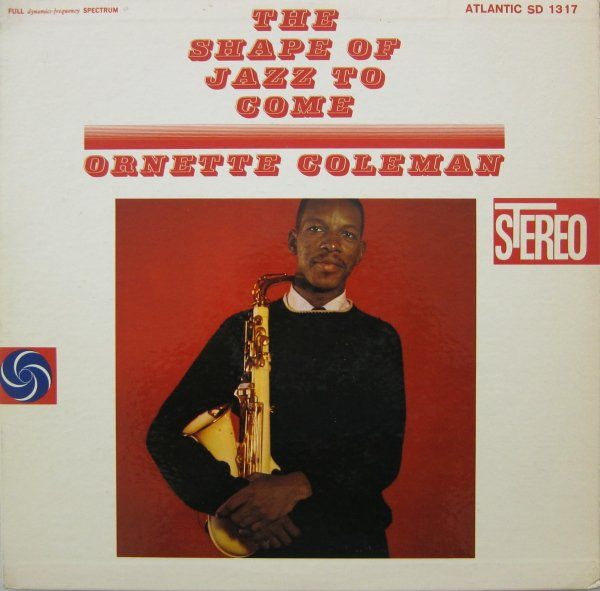
The Shape Of Jazz To Come is a Jazz album by Ornette Coleman, originally released in 1959. On Gatefold: 110 pressings tracked, owned by 51 collectors.
About
Of all the striking jazz innovations that coalesced in the year 1959, Ornette Coleman’s was the most radical. Miles Davis streamlined chord progressions and carved out room for melodic space on <i>Kind of Blue</i>. John Coltrane raised the bar on virtuosity with the relentless tempo and leaping key changes of <i>Giant Steps</i>. But Texas-born alto saxophonist Ornette Coleman eschewed conventional harmony and form altogether. And with <i>The Shape of Jazz to Come</i>, he began a stint with Atlantic Records that remains one of jazz’s grandest achievements. (The Atlantic years are compiled on <i>Beauty Is a Rare Thing</i>.) He also debuted one of the most expressive and atypical jazz quartets of all time, with Don Cherry on pocket trumpet, Charlie Haden on bass, and Billy Higgins on drums. “Coleman and Cherry may relate to the emotion, the pitch, the rhythm, the melody of a theme, without relating to ‘chords’ or bar divisions,” wrote the late critic Martin Williams in his liner notes. The alert 4/4 meter and walking bass of modern mainstream jazz was still often present, but during solos there might be no form at all—just interplay and creative exchange in the moment, a modality that later came to be called “time, no changes.” Framing these improvisations were Coleman’s inescapably singable melodies, from the captivating wail of the opening “Lonely Woman” to the quizzical calm of “Peace.” The melodies, or “heads” in jazz parlance, were usually voiced in unison: alto sax and trumpet, in the bebop manner. But the attack was rawer, the articulation more gestural and imperfect, the phrases wildly unpredictable (listen to the disorienting stop-start structures of “Focus on Sanity” and “Congeniality,” for instance). Coleman’s music arguably sparked the “free jazz” movement (named after the title of his 1961 epic, also on Atlantic). Yet the sound, at its heart, always conveyed what Williams called “a deep and personal feeling for the blues which is unmistakable.” Indeed, in its blues flavor, even harking back to the field hollers and folklore at the root of black music, Coleman’s jazz might have been the most traditional of all. His profound impact on others, from Coltrane to Pat Metheny and countless players of today, is everywhere apparent. <i>The Shape of Jazz to Come</i> was a provocative title back in 1959, but Coleman more than made good on the claim.
via Apple Music
The Clerk says
The Clerk knows this whole record — the pressing quirks, the credits, the take.
Tracklist
Side A
- A1Lonely Woman4:59
- A2Eventually4:20
- A3Peace9:04
Side B
- B1Focus On Sanity6:50
- B2Congeniality6:41
- B3Chronology6:05
Sound DNA
- Jazz
- Avant-Garde & Free Jazz
- abrasive
- chaotic
- cerebral
Recorded May 22, 1959. Also found on compilation CD set Beauty Is A Rare Thing (The Complete Atlantic Recordings).
Credits
The people behind it.
Performers
- Billy HigginsDRUMS
- Charlie HadenBASS DOUBLE BASS
- Don CherryTRUMPET
- Ornette ColemanALTO SAXOPHONE ALTO SAXOPHONE , COMPOSED BY ALTO SAXOPHONE, COMPOSED BY
- Don PayneBASS
- Percy HeathBASS
- Shelly ManneDRUMS
- Walter NorrisPIANO
51 collectors on Gatefold own this · 110 pressings tracked on Gatefold
Start your shelf.
Track your pressings of The Shape Of Jazz To Come, get the Clerk's take, and see what the record is worth — free.
Start your shelf →Free forever. Works with 10 records or 10,000.