
Album
Turbulence And Pulse
2022 · Electronic, Jazz
Rare pressing on Gatefold
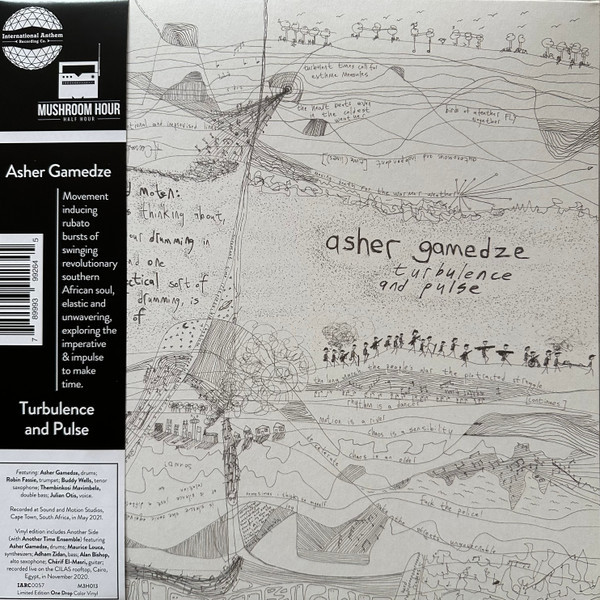
Turbulence And Pulse is a Jazz album by Asher Gamedze, originally released in 2022. On Gatefold: 3 pressings tracked.
About
On <i>Turbulence and Pulse</i>, drummer, composer, and cultural worker Asher Gamedze reunites with bassist Thembinkosi Mavimbela, saxophonist Buddy Wells, and trumpeter Robin Fassie to reform the quartet behind his debut album, 2020’s <i>Dialectic Soul</i>. Crafted during the pandemic, <i>Turbulence and Pulse</i> is a musical exploration of the interplay between notions of regulation and agitation. “The concept isn’t necessarily that pulse equals regulation equals oppression or that turbulence equals chaos equals liberation,” Gamedze tells Apple Music. “They’re always inter-articulating, with a sense of turbulence in the pulse and a sense of pulse in the turbulence.” Using the movement of time in a rhythmic and historical sense as a departure point, Gamedze expands on this organizing principle by interspersing textual and cultural references between melodic piano runs, free-flowing compositions, and his signature boundless drumming. “A productive metaphor exists between music and history,” Gamedze says. “In music it’s very clear that a sense of time is created by the people playing together—in history that’s hidden from us. If we take the understanding from music that time is created by people and apply that to history, we can understand that major historical processes are driven by ordinary people. We make time.” Gamedze talks us through the album, track by track. <b>“Turbulence’s Pulse”</b> “This is a piece that explains the concept of turbulence and pulse and how that relates to it in terms of its relationship to time—in music, society, and history. I’m thinking about them as separate and together, to see how different senses of time can help us think about how time moves in different paradigms. It’s about trying to understand ourselves as part of the historical process…to claim a sense of historical agency and say that, actually, history moves by the actions of ordinary people. It’s kind of an encouragement for us to organize and intervene in society ’cause that’s actually how time moves.” <b>“Wynter Time”</b> “In the first instance, this song is a tribute to [celebrated Jamaican novelist] Sylvia Wynter. There’s definitely a play on the idea of winter time and the idea of seasons being cyclical. There’s that sense of different historical moments, and the obvious reference to how some of Sylvia Wynter’s ideas relate to that. Part of the point is to link what’s often spoken about as a centuries-old struggle to now. When people think about the land question, they think about this original moment of dispossession that happens when colonists defeat people militarily anytime between the late 17th century and the early 20th century. Of course those are key moments in the process of land dispossession, but these processes are still ongoing and just take place differently.” <b>“Locomotion”</b> “I recorded demos of this on my computer and sent them to one of my good friends, who actually gave this track its name. I think it’s kind of interesting ’cause it’s both loose and propels you forward in a way. The form of the song is cyclical, so it’s about the groove. The train has been such a symbol and a material presence in the creation of modern South Africa. If you think about Bra Hugh Masekela’s track ‘Stimela,’ it’s about these locomotives that brought migrants to work on mines in South Africa.” <b>“If It Rains. to Pursue Truth”</b> “This is one of my favorite compositions, and when I was writing the song it was raining a lot; I guess it was winter in Cape Town. There’s all of these different ways in which rain relates. I don’t know; the sound of rain on the roof, but also the feeling of being inside while it’s raining, is something I’ve always enjoyed. Cosmologically, for many of our people in this part of the world, after someone passes, if it rains it’s a sign that they’ve been accepted into the realm of the ancestors.” <b>“Melancholia”</b> “The context out of which I wrote this was the intense violence of the first lockdown. I remember some of the first deaths in South Africa during COVID were actually people being killed by the police and army, and there were also really violent evictions done in the most dehumanizing ways. At the same time there were uprisings against police brutality in the States, and protests in the UK around racist colonial statues. There’s a sense of resistance here, but really it’s about the darkness of that moment—the unnecessary force of the state and the violence of organized racism.” <b>“Alibama”</b> “‘Alibama’ is a common song in the repertoire of Malay choirs and Kaapse Klopse. I didn’t grow up in that musical culture or tradition but I love, respect, and support it. I’ve always loved this song and wanted to pay tribute to it and contribute to that tradition from where I sit.” <b>“Can’t See the Sun”</b> “‘Can’t See the Sun’ is about how, sometimes, you only realize that you couldn’t see the sun for a while when either it comes out or you step outside. That can mean many different things and it’s open for people to pick up and make meaning as they will.” <b>“Sometimes I Think to Myself”</b> “This song is about the heartbreak of losing a friendship and basically having to find your own closure. It’s like, what do you do in a situation where someone who’s a really close friend seems uninterested in being that anymore? There’s no real conversation with them around what happened, so you’re on your own and you have to mourn the loss of someone who was important to you.” <b>“Out Stepped Zim”</b> “This is [a tribute to South African flutist and saxophonist] Zim Ngqawana, his philosophy, music, and movement throughout his life. He was always in motion and never satisfied with what he was given. He took those as things that needed to be extended and improvised with rather than things that were complete or static. He kept moving with the things he’d inherited, and he was emancipated rather than limited by them.” <b>“Underground Formation”</b> “To me there’s a gospel sensibility to this song that I only heard later, but I don’t really know what it is. The title is referring to a small group of people who study together and clandestinely plan to overthrow the conditions under which they live. It’s a group of people who keep alive a revolutionary impulse.”
via Apple Music
The Clerk says
The Clerk knows this whole record — the pressing quirks, the credits, the take.
Tracklist
- 1Turbulence's Pulse4:08
- 2Wynter Time9:27
- 3Locomotion4:07
- 4If It Rains. to Pursue Truth8:13
- 5Melancholia4:37
- 6Alibama2:59
- 7Can't See the Sun5:04
- 8Sometimes I Think to Myself5:20
- 9Out Stepped Zim6:34
- 10Underground Formation6:49
Sound DNA
- Jazz
- Post-Bop & Modal
- spiritual
- layered
- meditative
Credits
The people behind it.
Performers
- Asher GamedzeDRUMS
- Adham ZidanBASS
- Alan BishopALTO SAXOPHONE
- Buddy WellsTENOR SAXOPHONE
- Cherif El MasriGUITAR
- Maurice LoucaSYNTHESIZER
- Robin FassieTRUMPET
- Thembinkosi MavimbelaDOUBLE BASS
Rare pressing on Gatefold · 3 pressings tracked on Gatefold
Start your shelf.
Track your pressings of Turbulence And Pulse, get the Clerk's take, and see what the record is worth — free.
Start your shelf →Free forever. Works with 10 records or 10,000.