
Artist
Asaf Avidan
Jerusalem, Israel · b. 1980
Asaf Avidan is a musician from Jerusalem, Israel, active since 1980. Their discography on Gatefold includes 5 records.

5
Albums tracked
4
In collections
1980
Since
Biography
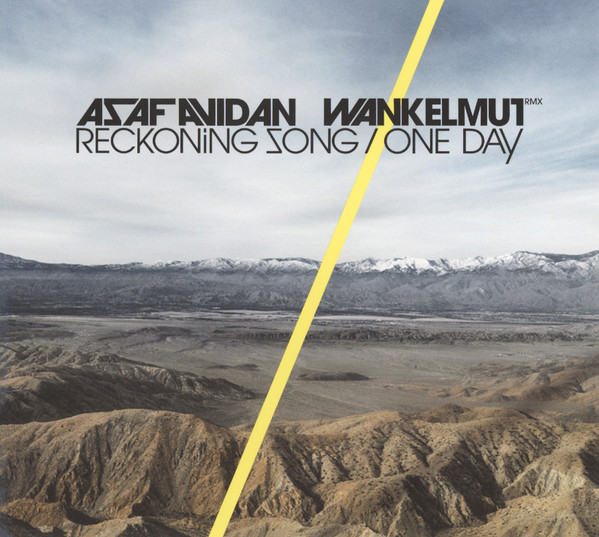
Before he ever sang a note on a record, Asaf Avidan was a classic animator who got his heart absolutely ripped out by a long-term breakup. He didn't pick up a guitar to make a career. He picked up a cheap acoustic to stop himself from staring at the walls. That desperation is all over his 2006 self-released EP, Now That You're Leaving. He tracked those songs in Tel Aviv with zero industry expectations, armed only with a throat that sounded like it had been scraped with rusted steel wool. Then German producer Wankelmut grabbed "Reckoning Song," slapped a four-on-the-floor house beat under Avidan's acoustic lament, and created a monster. The remix went ten times platinum across Europe while Avidan was trying to establish himself as a serious folk-rock frontman with his band, the Mojos. That tension defined his entire early career. He was a blues-obsessed traditionalist suddenly forced to play festival main stages to crowds waiting for a tech-house drop. He hated the compromise, broke up his band at the peak of their run, and went solo to reclaim his own voice. Avidan's solo work is a masterclass in studio isolation. He started treating the recording process like his old animation desk, obsessing over every frame. He abandoned the standard guitar-bass-drums setup for synthesizers, woodwinds, and weird pitch-shifted vocal layers that he tracked entirely by himself. He turned his high-pitched, androgynous rasp into an instrument of pure theater. It is demanding, abrasive, and brilliant when he pulls it off.
Bio from The Clerk
The Arc of Asaf Avidan
The pivots — what forced Asaf Avidan to reinvent.
The Mojo Years
Between 2006 and 2011, Avidan anchored himself to the Mojos to build a raw, sweaty blues-rock engine. They tracked three records of dirty, sixties-indebted folk-rock that positioned them as Israel's answer to the blues revival. The band’s live energy was massive, but the massive international success of the unauthorized Wankelmut club remix of 'Reckoning Song' split the band's identity in half. Avidan dissolved the group at their commercial peak because he refused to become a touring karaoke act for a dance remix.
The Electronic Pivot
Avidan retreated to the studio with producer Tamir Muskat of Balkan Beat Box to completely rebuild his sound for 2012's Different Pulses. He traded the dirty garage-blues of the Mojos for cold analog synthesizers, programmed drum loops, and dramatic brass arrangements. Muskat pushed Avidan's vocals to the absolute front of the mix, dry and unadorned against the electronic backdrops. The result was a stark, theatrical pop record that proved he did not need a traditional rock band to sound heavy.
The Nashville Session
For 2017's The Study on Falling, Avidan flew to California and Nashville to record with producer Mark Howard, who had engineered classics for Bob Dylan and Tom Waits. Howard brought in elite session players like keyboardist Mickey Raphael and drummer James Gadson to capture a warm, tape-saturated Americana vibe. They recorded mostly live to analog tape, forcing Avidan to abandon his perfectionist editing habits. You can hear the room on this record, especially in the way the acoustic guitars rattle against Avidan's weathered vocals.
Influences
- Janis Joplin — Critics have compared Avidan to Joplin since his debut, a comparison he embraced by covering 'Move Over' live during his early tours. You hear this influence in his uninhibited vocal delivery, particularly the way he pushes his falsetto into a gravelly, throat-shredding scream. He mimics her raw, unpolished passion rather than traditional blues vocal control.
- Bob Dylan — Avidan has repeatedly cited Dylan's mid-sixties output as his songwriting blueprint, specifically pointing to the lyrical density of 'Subterranean Homesick Blues.' You hear this influence in the wordy, stream-of-consciousness narratives on his debut EP, Now That You're Leaving. He adopts Dylan's nasal phrasing and use of the harmonica as an emotional punctuation mark.
- Leonard Cohen — Avidan often notes Cohen's ability to blend religious imagery with secular heartbreak, a technique he heavily borrowed for his solo albums. This influence is most obvious on Gold Shadow, where the sparse arrangements and dark, poetic lyricism directly mirror Cohen's late-career minimalism. He uses Cohen's quiet, methodical pacing to balance his own chaotic vocal style.
- Billie Holiday — Avidan has explicitly credited Holiday with teaching him how to use vocal phrasing to convey pain without relying on volume. You hear this on the quieter ballads of Different Pulses, where he drags his vocals slightly behind the beat to create a sense of exhaustion and longing. He mimics her ability to turn a simple vowel stretch into a dramatic event.
- Led Zeppelin — During his years fronting the Mojos, Avidan frequently covered 'Babe I'm Gonna Leave You' in concert, showcasing his ability to match Robert Plant's dynamic range. You hear this influence in the heavy, acoustic-driven blues riffs that anchor his early albums like The Poor Boy & The Grave Digger. He took Plant's approach of treating the rock vocal as a lead instrument capable of cutting through loud guitar tracks.
Discography
Their records — most-collected first.


Related artists
Frequent collaborators
Around the web
Follow every record they touch.
Start your shelf and Gatefold tracks Asaf Avidan's new pressings, tour dates, and the whole discography — automatically.
Start your shelf →Free forever. Works with 10 records or 10,000.