Artist
Cluster
Cluster is a music group. Their discography on Gatefold includes 7 records.

7
Albums tracked
36
In collections
—
Since
Biography
Moebius and Roedelius didn't start with synthesizers. They started with an alarm clock, some feedback, and a car battery in a Kreuzberg basement. When they split from Conrad Schnitzler and Kluster became Cluster in 1971, they were basically a noise duo using contact mics on kitchen scrap. They were barely musicians in the traditional sense. It was just Conny Plank behind the board at Star-Studios trying to make sense of the industrial racket they were making with a bunch of manipulated electronics and an organ. Then they moved to a rural commune in Forst and everything changed. The heavy industrial gloom of West Berlin got swapped for the sound of the Weser river and the buzzing of insects. That’s where the real magic happened. They pivoted from terrifying noise to these tiny, fragile, rhythmic sketches that basically predicted everything from ambient to techno. They didn't have a drummer, so they treated the rhythm like a mechanical heartbeat. It’s some of the most human-sounding electronic music ever made because it’s so flawed and handmade.
Bio from The Clerk
The Arc of Cluster
The pivots — what forced Cluster to reinvent.
The Industrial Noise Phase
After Schnitzler left, Moebius and Roedelius took the 'K' off the name and doubled down on the chaos with Conny Plank. They were using a Farfisa organ and a battery of effects pedals to create these massive, harrowing drones that felt like a factory collapsing in slow motion. You hear it on the self-titled debut where the tracks don't have titles, just durations. It was the sound of Berlin's claustrophobia before they found a way to breathe.
The Forst Pastoral Shift
Moving to the countryside in 1973 completely broke their sound open. They hooked up with Michael Rother from NEU! to form Harmonia, and that motorik influence bled right back into Cluster’s own Zuckerzeit. Suddenly the drones were gone, replaced by short, melodic vignettes recorded on a Nagra four-track. They were using cheap drum machines and primitive synths to create a weird, electronic folk music that felt light and airy for the first time.
The Eno Collaborations
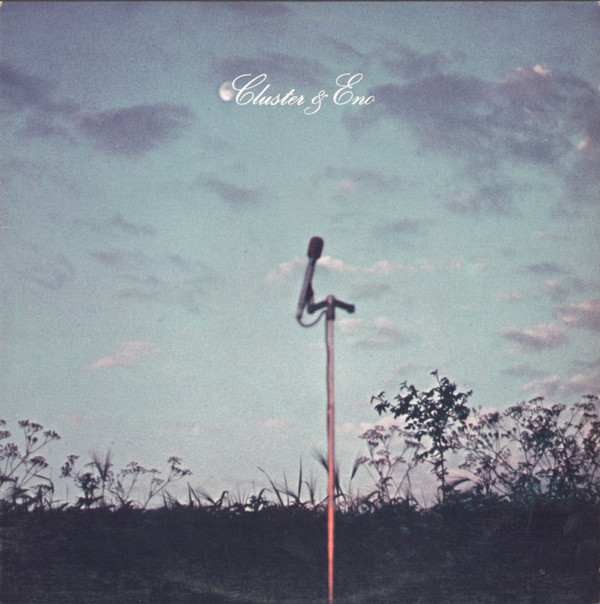
Brian Eno saw them play in Hamburg and realized they were already doing what he was trying to invent with ambient music. He showed up at their studio in Forst with no plan other than to soak up the atmosphere. These sessions resulted in Cluster & Eno and After the Heat, where the duo's minimalist sketches met Eno’s pop sensibilities and production sheen. It turned their experiments into something structured and vocal-driven, grounding their abstractions in a way that made the label suits at Sky Records happy.
Influences
- Karlheinz Stockhausen — Roedelius and Moebius were deep into the Cologne school of electronic composition. You hear the DNA of 'Gesang der Jünglinge' in the way they manipulated magnetic tape and sine waves during their early years. It’s the academic root of their sonic vandalism.
- The Velvet Underground — Moebius frequently cited the Velvets' use of sustained drone as a primary gateway for his own interest in repetition. The jagged, repetitive pulse of 'Sister Ray' is the blueprint for the long-form improvisations they did in the early 70s. It’s art-rock stripped of the rock.
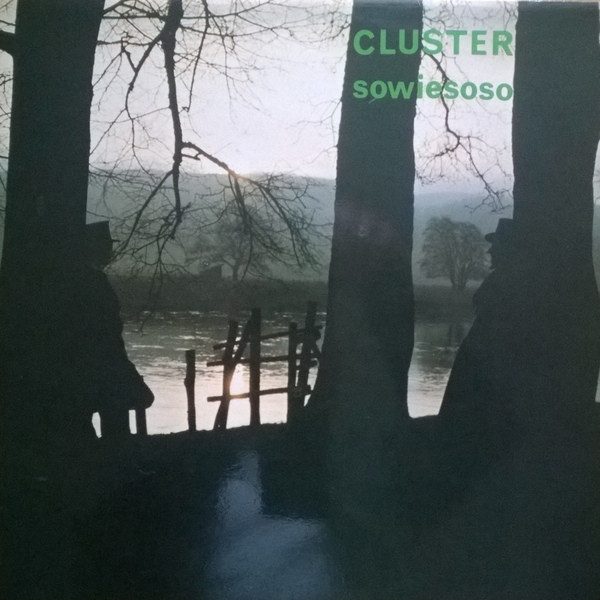
- Terry Riley — The duo were obsessed with 'A Rainbow in Curved Air' and the concept of additive patterns. You hear Riley's influence all over 'Zuckerzeit' and 'Sowiesoso' where small melodic cells repeat and shift against each other. They took the high-art minimalism and made it sound like a toy box.
- Conrad Schnitzler — As their mentor in the original Kluster lineup, he taught them that any object could be an instrument. His total disregard for melody forced them to find a way to create tension through texture alone. Even after they split, his 'everything is a sound' philosophy remained their North Star.
- James Brown — Moebius was a massive fan of the Godfather of Soul's rhythmic precision. In interviews, he credited Brown's focus on 'The One' as the reason Cluster's electronic pulses felt so funky despite being played by machines. It’s the secret ingredient that keeps their rhythms from feeling sterile.
Discography
Their records — most-collected first.



Around the web
Follow every record they touch.
Start your shelf and Gatefold tracks Cluster's new pressings, tour dates, and the whole discography — automatically.
Start your shelf →Free forever. Works with 10 records or 10,000.