
Artist
Clúster
Argentine singer
Buenos Aires · b. 2003
Clúster is a musician from Buenos Aires, active since 2003. Their discography on Gatefold includes 7 records.

7
Albums tracked
36
In collections
2003
Since
Biography
Clúster didn't start with synthesizers. They started with a contact mic and a pile of scrap metal in a West Berlin gallery. Hans-Joachim Roedelius and Dieter Moebius were part of the Zodiak Free Arts Lab crew, which was less of a music scene and more of a collective nervous breakdown. Their early work as Kluster—with a 'K'—was purely industrial noise recorded on a shoestring budget for the Schwann label. It’s the sound of a construction site being fed through a distortion pedal, and honestly, it’s a tough listen if you aren't in the mood for sonic warfare. Everything changed when they moved to the rural village of Forst and swapped the chaos for a Farfisa organ and a cheap drum machine. They dropped the 'K' and brought in Michael Rother from NEU! for a stretch, which finally gave the noise some structural integrity. By the time they hooked up with Brian Eno in the late '70s, they weren't just making background music; they were inventing the vocabulary for half the ambient and synth-pop records that clogged up the bins in the eighties. They could be maddeningly repetitive, but when they locked into a groove, they found a warmth that the Kraftwerk robots could never touch.
Bio from The Clerk
The Arc of Clúster
The pivots — what forced Clúster to reinvent.
The Kluster Noise Years
Before the vowel change, the duo teamed up with Conrad Schnitzler to create a trio of records that are basically industrial blueprints. They were using alarm clocks, kitchen utensils, and broken electronics to create a wall of sound that lacked any traditional melody. These sessions were captured live with minimal overdubs, resulting in the abrasive textures found on Klopfzeichen. It’s the sound of the Berlin underground before it found the groove, raw and completely uninterested in being liked.
The Forst Pastoral Period
Moving to a communal house in the countryside of Forst changed the hardware and the headspace. Moebius and Roedelius started leaning into the rhythmic possibilities of the Elka Drummer and various Korg units, resulting in the lighter, rhythmic pulses of Zuckerzeit. Michael Rother's presence as a co-producer injected a sense of motorik momentum that hadn't existed in their earlier, jagged work. This is where the music stops being a threat and starts becoming a landscape, characterized by short, melodic vignettes that feel like clockwork toys.
The Eno Collaborations
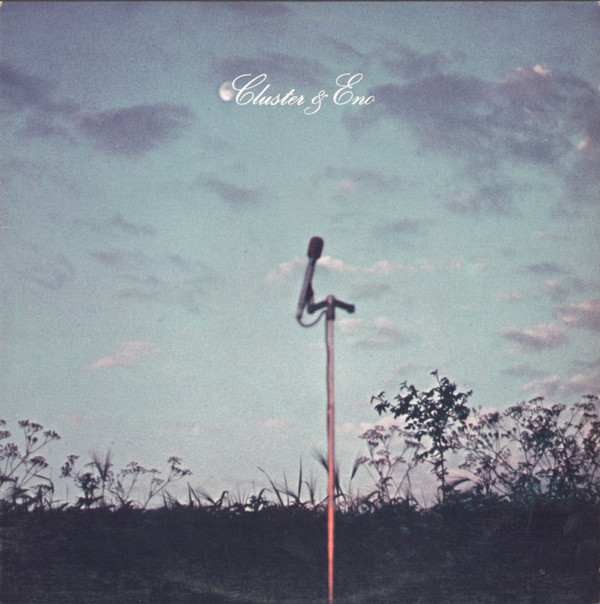
When Brian Eno showed up at their studio after hearing them in Hamburg, the dynamic shifted toward a high-concept minimalism. The recordings for Cluster & Eno and After the Heat brought a structured, British sensibility to their German improvisations. You can hear Eno’s 'Oblique Strategies' at work in the way the tracks breathe, trading the heavy sequencing for delicate piano melodies and tape loops. It forced the duo to think about the space between the notes, leading to some of the most accessible yet haunting work in their entire catalog.
Influences
- Karlheinz Stockhausen — Roedelius has explicitly cited Stockhausen's electronic experiments as the reason they felt permitted to abandon traditional instruments. You hear it in the way they treat the studio as an instrument itself, particularly the use of sine waves and filtered noise on the self-titled 1971 LP. It’s the academic root of their street-level chaos.
- The Velvet Underground — Moebius frequently pointed to the Velvets as their primary rock-and-roll reference for their embrace of drone and repetition. The heavy, locked-in pulse of 'Sister Ray' is the direct ancestor to the long-form improvisations Clúster would later refine. It’s the street grit beneath the electronic polish.
- Conrad Schnitzler — As their mentor and third member during the Kluster era, Schnitzler brought the conceptual art-house aggression to the group. His influence is why those early records sound like a factory malfunction rather than a band practice. Without his push toward the extreme, they might have stayed in the folk-rock lane.
- Terry Riley — The modular repetition found in Riley's 'A Rainbow in Curved Air' provided the blueprint for the additive synthesis Moebius and Roedelius used on Zuckerzeit. You can hear the DNA of Riley’s minimalist cycles in the way their synth lines phase in and out of sync. It turned their noise into mathematics.
- Pink Floyd — Before they went to the moon, the early Barrett-era Floyd was a fixture in the Berlin clubs where Clúster got their start. The sprawling, space-rock organ textures of 'Interstellar Overdrive' directly informed the hazy, psychedelic drift of the Cluster II sessions. It’s the bridge between 60s acid rock and 70s kosmische.
Discography
Their records — most-collected first.



Around the web
Follow every record they touch.
Start your shelf and Gatefold tracks Clúster's new pressings, tour dates, and the whole discography — automatically.
Start your shelf →Free forever. Works with 10 records or 10,000.