
Artist
George Otsuka Quintet
George Otsuka Quintet is a music group. Their discography on Gatefold includes 4 records.
4
Albums tracked
1
In collections
—
Since
Biography
Keiji "George" Otsuka (ジョージ大塚, April 6, 1937 – March 10, 2020) was a Japanese jazz drummer. Otsuka first began playing professionally with Sadao Watanabe's quartet toward the end of the 1950s. He worked for several years with Hidehiko Matsumoto in the 1960s, then led his own trio with Hideo Ichikawa, in addition to working with Roy Haynes. He was a member of the Four Drums ensemble which did a tour of Japan in 1970; Jack DeJohnette, Roy Haynes, and Mel Lewis were the other drummers in this group.
The Arc of George Otsuka Quintet
The pivots — what forced George Otsuka Quintet to reinvent.
The Three Blind Mice Foundation
Otsuka was the backbone of the legendary Three Blind Mice label, providing the rhythmic muscle for the Tsuyoshi Yamamoto Trio before carving out his own space. This era was defined by the label’s obsessive engineering standards, capturing every nuance of his cymbal work with frightening clarity. You hear a drummer who has mastered the technical demands of bop but is clearly looking for a way to break the structure. It was the sound of a session pro realizing he had the gravity to pull an entire scene into his own orbit.
The Fusion Pivot
The shift happened when the acoustic piano started getting swapped for the Fender Rhodes and the compositions leaned into longer, more atmospheric vamps. Bringing in Hideo Ichikawa and later Fumio Karashima changed the DNA of the quintet, moving them away from the smoke-filled club vibe toward a more expansive, electric reality. This wasn't a commercial sellout to the burgeoning City Pop scene, but a genuine attempt to match the electric Miles Davis intensity coming out of the States. The records became heavier, more rhythmic, and significantly more aggressive.
Influences
- Elvin Jones — Otsuka openly modeled his aggressive, rolling triplet feel and polyrhythmic approach after Jones's work with John Coltrane. You hear it in the way he pushes the tempo just past the point of comfort on 'Sea Breeze.' He wasn't just a fan; he was a student of the physical power Elvin brought to the kit.
- Tony Williams — The shift toward high-energy fusion in the mid-70s was a direct response to the template Williams set with Lifetime. Otsuka mirrored Williams's use of heavy cymbal washes and the integration of rock-leaning dynamics into a jazz context. It turned the quintet from a swing machine into a powerhouse.
- Art Blakey — Blakey’s influence is all over Otsuka’s early hard-bop sessions and his philosophy as a bandleader. He adopted Blakey’s 'thunder' technique on the snare and the habit of using his quintet as a finishing school for the best young soloists in Tokyo. The DNA of the Jazz Messengers is the foundation of his entire early catalog.
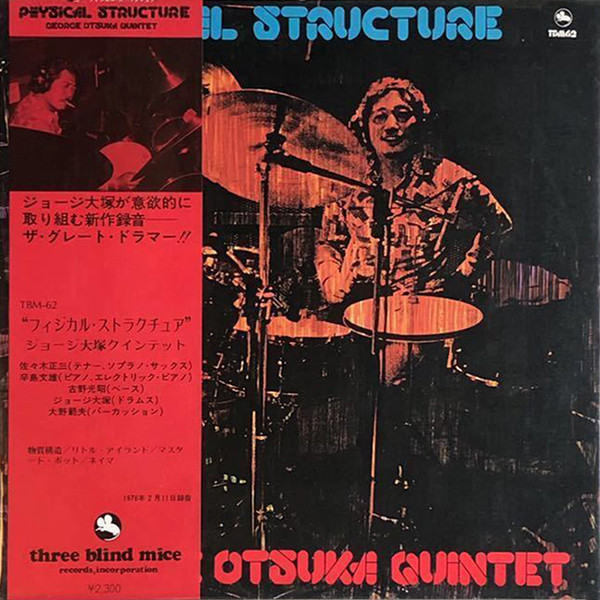
- Miles Davis — The quintet’s transition into 'Physical Structure' mirrors the electric period of Davis, particularly in the use of space and electronic textures. Otsuka pushed his keyboardists to adopt the same dissonant, rhythmic Rhodes playing that Miles demanded from his sidemen. It changed the quintet from a traditional unit into a experimental lab.
- Max Roach — Otsuka frequently cited Roach’s melodic drumming and solo construction as the primary reason he moved beyond being a simple timekeeper. You can hear Roach's influence in the structured, narrative way Otsuka takes his extended breaks. He treated the drum kit as a melodic instrument rather than just a noise generator.
Discography
Their records — most-collected first.



Related artists
Around the web
Follow every record they touch.
Start your shelf and Gatefold tracks George Otsuka Quintet's new pressings, tour dates, and the whole discography — automatically.
Start your shelf →Free forever. Works with 10 records or 10,000.