Artist
Ron Trent
house DJ & producer from Chicago, US
Chicago, United States · b. 1973
Ron Trent is a musician from Chicago, United States, active since 1973. Their discography on Gatefold includes 11 records.

11
Albums tracked
7
In collections
1973
Since
Biography
Ron Trent tracked "The Afterlife" and "Altered States" as a high school kid in Chicago using an Oberheim drum machine, a Roland synth, and a cassette deck. Armando grabbed "Altered States" for Warehouse Records in 1990, and that twelve-minute techno-house hybrid wrecked dancefloors internationally. It wasn't standard four-on-the-floor Chicago jack track fare. The tempo shifts and layered polyrhythms pushed well past what guys like DJ Pierre were doing with raw 303s, giving house music a cerebral, percussion-heavy backbone. Then he met Chez Damier at Detroit's Music Institute, moved back to Chicago, and launched Prescription Records in 1993. That imprint basically wrote the holy book for deep house. While European dance music spent the late nineties chasing cheap, aggressive stadium trance builds, Trent stayed obsessed with acoustic Rhodes runs, live bass, and Afro-Cuban pocket grooves. He never cashed out. He just kept digging deeper into percussion systems and analog consoles.
Bio from The Clerk
The Arc of Ron Trent
The pivots — what forced Ron Trent to reinvent.
The Prescription Era
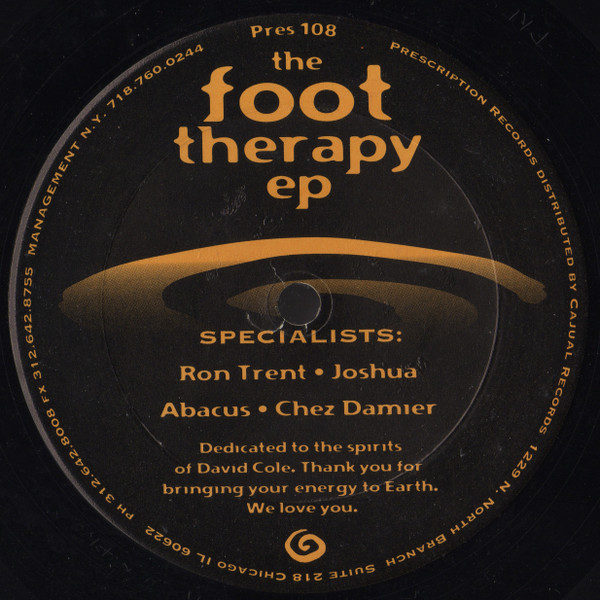
Teaming up with Chez Damier in 1993 birthed Prescription Underground, shifting house music away from peak-hour rave noise toward lush, hypnotic chord voicings. The pair lived in the studio, cutting stone-cold essentials like "Morning Factory" and "The Choice" that relied heavily on ambient dub pads, stripped-back drum programming, and unquantized jazz phrasing. Those twelve-inches completely redefined what American deep house could sound like. You can hear every bit of that warm, basement-engineered dynamic range across their joint catalog from 1993 to 1997.
The Afro-Cuban & Organic Jazz Pivot
Relocating to New York in the late nineties brought Trent into the orbit of the Body & SOUL scene and live session musicians. He launched the Urban Sound Gallery and Future Vision imprints, pivoting hard toward Afrocentric polyrhythms, Latin percussion, and expansive Fender Rhodes arrangements on records like Primitive Arts. Synthesizers took a back seat to live congas, unquantized basslines, and marathon instrumental suites. It established Trent as a serious composer rather than just a drum-machine programmer.
Warm City Balearica
After decades holding down the underground club circuit, Trent broadened his scope with his WARM project and the 2022 LP What Do the Stars Say to You. He brought in heavyweight collaborators like Khruangbin, Gigi Masin, and Jean-Luc Ponty, leaning into widescreen AOR, yacht-adjacent soul, and ambient jazz fusion. François Kevorkian came in for the mix engineering, giving the record a massive, pristine, open-air dynamic range. It proved his deep house sensibilities could translate to fully fleshed-out, headphone-focused studio albums.
Influences
- Ron Hardy — Trent grew up attending the Music Box, where Hardy's aggressive reel-to-reel edits and raw EQ sculpting completely shaped his understanding of club dynamics. You hear Hardy's relentless percussive intensity directly in the unhinged tempo accelerations of "Altered States." If Trent didn't spend his youth standing near the Music Box speaker stacks, modern house percussion would sound completely different.
- Frankie Knuckles — Knuckles broke Trent's earliest records at the Power Plant and set the gold standard for lush, emotionally resonant Chicago house. That gospel-tinged musicality and patient pacing live at the very core of Trent's melodic chord work on Prescription Records. Knuckles gave him the blueprint for letting a groove breathe for ten minutes without ever sounding empty.
- Lonnie Liston Smith — Trent's father was an avid record collector and percussionist who fed him a steady diet of seventies spiritual jazz, with Smith's Cosmic Echoes sitting at the top. The atmospheric Fender Rhodes keys and astral synth textures throughout Trent's catalog trace directly back to Smith's Flying Dutchman recordings. It turned what could have been generic club tracks into cosmic jazz workouts.
- Fela Kuti — Kuti's complex Afrobeat structures and interlocking percussion sections served as Trent's rhythmic masterclass. You hear it across his Latin and African Blues projects, where layered shakers, talking drums, and off-beat horn stabs dictate the flow instead of standard drum grid loops. Trent treated the drum kit like an orchestra, exactly the way Tony Allen and Fela did.
- Herbie Hancock — Hancock's transition from jazz purism to Mwandishi-era electronics and synth-heavy funk directly influenced Trent's keyboard playing and studio philosophy. The wandering, modal synth solos and tight analog basslines on records like Primitive Arts borrow heavily from Hancock's seventies fusion palette. Trent took jazz-funk improvisation and welded it directly to an electronic pulse.
Discography
Their records — most-collected first.




Related artists
Bands & projects
Frequent collaborators
Around the web
Follow every record they touch.
Start your shelf and Gatefold tracks Ron Trent's new pressings, tour dates, and the whole discography — automatically.
Start your shelf →Free forever. Works with 10 records or 10,000.