Artist
Terry Snyder and The All Stars
Terry Snyder and The All Stars is a music group. Their discography on Gatefold includes 3 records.

3
Albums tracked
7
In collections
—
Since
Biography
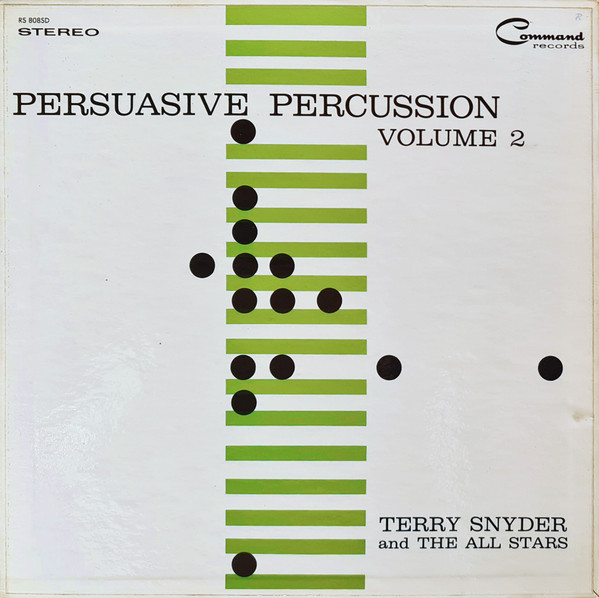
Command Records boss Enoch Light didn't care about the charts when he booked Fine Recording Studios in 1959. He wanted to sell stereo systems to suburbanites. He brought in Terry Snyder, a veteran staff percussionist at WNEW, and crammed a room full of session heavyweights like Tony Mottola and Dick Hyman to exploit the newly minted two-channel stereo format. They weren't writing songs. They were weaponizing left-to-right panning to prove to middle-class dads that their expensive new home stereos actually worked. The resulting record, Persuasive Percussion, became an accidental monster. The setup was brutal on the players. They had to record live to two-track 35mm magnetic film, which meant no tape hiss but zero room for error. Snyder kept time while bongos, vibes, and woodblocks bounced back and forth between the speakers like a ping-pong match. It was clinical, mathematically precise, and completely devoid of warmth. Yet, it practically built the lounge and space-age pop movement overnight.
The Arc of Terry Snyder and The All Stars
The pivots — what forced Terry Snyder and The All Stars to reinvent.
The Command Stereo Boom
In 1959, the arrival of dual-channel vinyl mastering changed everything for session players. Enoch Light put Snyder in charge of the All Stars to record Persuasive Percussion on 35mm film instead of standard magnetic tape. This gear shift forced the musicians to play with razor-sharp separation so the stereo channels wouldn't bleed together. You can hear the physical isolation on the record, with Snyder's bongos hard-panned left and Mottola's guitar answering hard-right. It was a technical demonstration disguised as a dance record, and it sold millions to people who just wanted to hear their speakers work.
The Direct Competitor Pivot
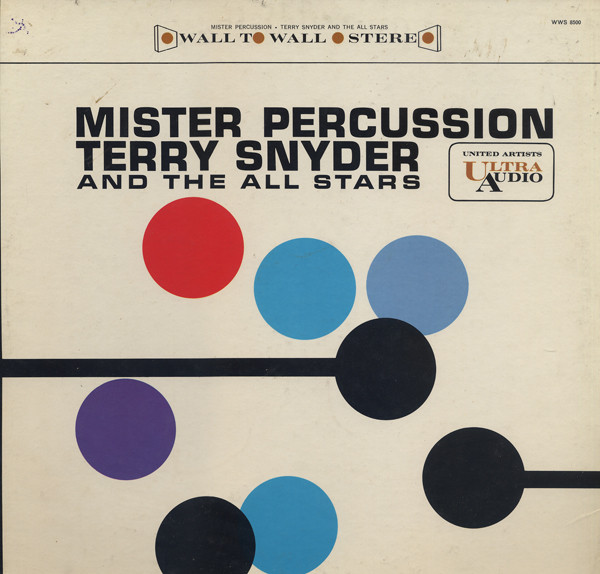
By 1960, major labels realized Enoch Light was eating their lunch with these high-fidelity demonstration discs. United Artists lured Snyder away from Command to record Mister Percussion with his own orchestra, attempting to duplicate the exact same stereo tricks with bigger budgets. The production got slicker, but the raw novelty of the extreme panning started to wear thin as the market flooded with cheap knockoffs. Snyder's departure forced Light to hire Bobby Byrne to lead the Command franchise, effectively splitting the original All Stars camp in two.
Influences
- Les Paul — Les Paul pioneered multi-track recording and sound-on-sound overdubbing in the early 1950s. Snyder's entire approach to channel separation and studio-as-an-instrument trickery stems directly from Paul's early Capitol singles. You can hear this influence in the dry, close-miked guitar sounds Tony Mottola used on the All Stars sessions.
- Perez Prado — Prado popularized the mambo and exotica rhythms in the mid-1950s, which served as the structural template for Snyder's percussion arrangements. The All Stars covered Prado's 'Cherry Pink and Apple Blossom White' on their debut LP. Snyder stripped away Prado's brassy chaos to focus entirely on the polyrhythmic skeleton underneath.
- Tito Puente — Puente's heavy timbale work on Tico Records in the 1950s brought Afro-Cuban percussion to the forefront of American pop instrumental music. Snyder adapted Puente's syncopated rimshots and cowbell patterns for suburban living rooms. You can hear the direct lift of Puente's rhythm section dynamics on Snyder's version of 'I Love Paris'.
- George Shearing — Shearing's late-1940s quintet established the cool, polite jazz sound that combined block-chord piano with vibraphone. Snyder utilized this exact instrumental pairing on 'Persuasive Percussion' to fill the mid-range frequencies between his panning drum tracks. The smooth vibe-and-guitar unison lines on 'Blue Tango' are straight out of the Shearing playbook.
- Xavier Cugat — Cugat was the king of commercializing Latin rhythms for white American audiences at the Waldorf-Astoria. Snyder took Cugat's orchestral rumba and mambo templates and stripped out the live room reverb for a dry, sterile studio environment. The choice of material on the first All Stars record heavily mirrors Cugat's standard radio repertoire.
Discography
Their records — most-collected first.

Related artists
Members
Around the web
Follow every record they touch.
Start your shelf and Gatefold tracks Terry Snyder and The All Stars's new pressings, tour dates, and the whole discography — automatically.
Start your shelf →Free forever. Works with 10 records or 10,000.