Performance · Other credits
Eduard Künneke
Eduard Künneke is credited on 649 releases across 171 albums tracked on Gatefold, active 1952–2022 — the collector-built map of who actually made the music.

649
Pressings credited
171
Albums
8
Decades active
—
In collections
Biography
Eduard Künneke (also seen as Edward and spelled Künnecke) (27 January 1885 – 27 October 1953 in Berlin) was a German composer notable for his operettas, operas, theatre music and some orchestral works. Kuenneke was born in Emmerich, Lower Rhine. After obtaining his school diploma he moved in 1903 to Berlin where he studied musicology and the history of literature; he translated Beowulf into German. He was subsequently accepted into Max Bruch's master-school for musical composition attached to the Royal Academy of Arts. By 1907 Kuenneke was already a repetiteur and chorus master at a Berlin operetta theatre, the Neues Operettentheater am Schiffbauerdamm, but relinquished his post as chorus master after his opera Robins Ende (1909) was premiered in Mannheim and Coeur-As (1913) in Dresden. Thereafter he received productions at 38 German opera houses. From 1908 to 1910 he also worked as a music director for Odeon Records and conducted (without label credit) two of the earliest complete symphony recordings, the Beethoven Fifth and Sixth Symphonies with the "Grosses Odeon Streich-Orchester". In 1911 Künneke became a conductor of the German Theatre in Berlin, where he wrote incidental music for Max Reinhardt including music for Reinhardt’s staging of Part Two of Goethe's Faust. With the coming of The Great War he became a horn player and conductor in a regimental band. In 1916 the focus of his interests began to shift to musical comedy. However, due to financial woes he took a post as serial conductor for Heinrich Berté's prettified Schubert pastiche Das Dreimaderlhaus (Blossom Time). This inspired him to write an equally maudlin singspiel Das Dorf ohne Glocke (The Village without a Bell)(1919). Subsequently he composed one operetta after another, altogether more than a dozen, and all at a high level of craftsmanship. He toured the US but, as one writer put it, "his experiences were not exactly positive". During the National Socialist years he advanced to become the "Maste
Bio from Wikipedia
Credited work
649 releases · 171 albums · active 1952–2022
- Performance · 820
- Other credits · 59
Studios: Studio Christuskirche, Berlin · Evangelisches Gemeindehaus, Berlin-Zehlendorf · Admiralspalast, Berlin · Grunewaldkirche
Discography
Records they worked on — most-collected first.

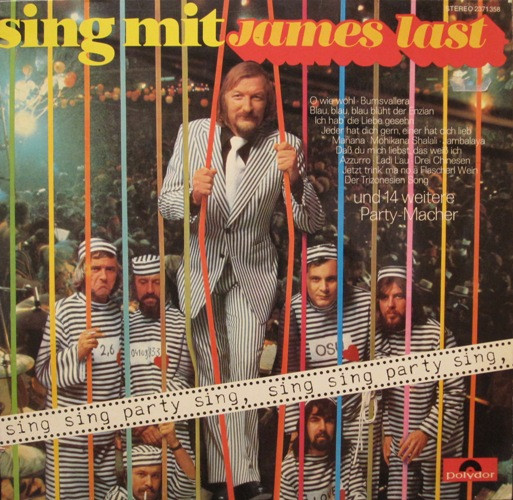
Frequent collaborators
- Various
- Peter Anders (2)
- Fritz Wunderlich
- Rudolf Schock
- Peter Alexander
- Herta Talmar
- Anneliese Rothenberger
- Klaus Wunderlich
Around the web
See who really made the music.
Gatefold maps every producer, engineer, and player across your shelf — the credits no one else surfaces.
Start your shelf →Free forever. Works with 10 records or 10,000.