
Performance · Other credits
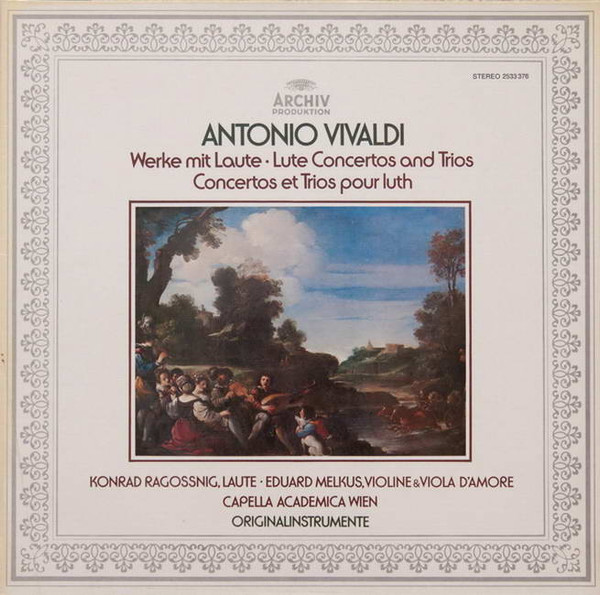
Eduard Melkus
Eduard Melkus is credited on 372 releases across 89 albums tracked on Gatefold, active 1959–2022 — the collector-built map of who actually made the music.
372
Pressings credited
89
Albums
8
Decades active
2
In collections
Biography
Eduard Melkus (born 1 September 1928 in Baden bei Wien) is an Austrian violinist and violist. Following the Second World War, Melkus dedicated himself to the exploration of historically informed performance. He was a member of the 1949 Vienna viola da gamba quartet, a select group of musicians that included Alice and Nikolaus Harnoncourt and the harpsichordist Gustav Leonhardt. In the years that followed, he was also noted as a champion of new music. From 1958, Melkus was a professor of violin, baroque violin, viola, and historical performance practice at the Vienna Academy of Music. From September 1972 to January 1975, he flew in to teach violin at the University of Georgia in Athens, Georgia, USA. In 1982 he became head of the Institute for Viennese Sound Style. He performed and recorded more than 200 works from the mid 17th through the early 19th centuries with his ensemble Capella Academica Wien, or the French harpsichordist Huguette Dreyfus. In his time, he tapped a worldwide audience before being replaced as a violin soloist by a new wave in the revival of historically informed baroque period performance--a movement called "early music." Melkus' style included elements that came to be eschewed by the later "early music" orthodoxy: the use of the wire E-string rather than gut, the A=440 pitch standard adopted in 1896 (as opposed to lower "baroque" pitch), a chin-rest--though used by many "early music" violinists anyway (in addition to or alternating with 20th-century orthopedic devices like hidden shoulder rests), and unsparing vibrato. He took different path from his better-know Viennese colleagues Nikolaus and Alice Harnoncourt, with whom he began in the studio of keyboardist Isolde Ahlgrimm with her husband Erich Fiala. He was also at odds with the later principals of the "early music" movement in Holland, England, and the US. However, history and reflection have demonstrated that Melkus was better-informed. The wire E-string was the result of two centuries'
Bio from Wikipedia
Credited work
372 releases · 89 albums · active 1959–2022
- Performance · 525
- Other credits · 65
- Mastering · 3
Studios: Palais Schönburg · Kirche Neumünster, Zürich · Jesus-Christus-Kirche, Berlin · Kirche St. Emmeram, Regensburg
Discography
Records they worked on — most-collected first.
Frequent collaborators
- Johann Sebastian Bach
- Georg Philipp Telemann
- Antonio Vivaldi
- Georg Friedrich Händel
- Various
- Bach
- Claudio Monteverdi
- Mozart
Around the web
See who really made the music.
Gatefold maps every producer, engineer, and player across your shelf — the credits no one else surfaces.
Start your shelf →Free forever. Works with 10 records or 10,000.